If we respect nature, would we still damage it as much as we do today?
And would we have set out on the race to win over and conquer (rest of the) nature with the unending zeal that we see in proliferation of technologies and innovations, that directly or indirectly depend on extraction of nature as a resource?
If we respected all other humans and thought with compassion about them when making decisions, would we have so much climate injustice?
If we respect view of others that we disagree with, would we have so much political polarization and lack of cooperation in resolving our differences or living harmoniously despite differences?
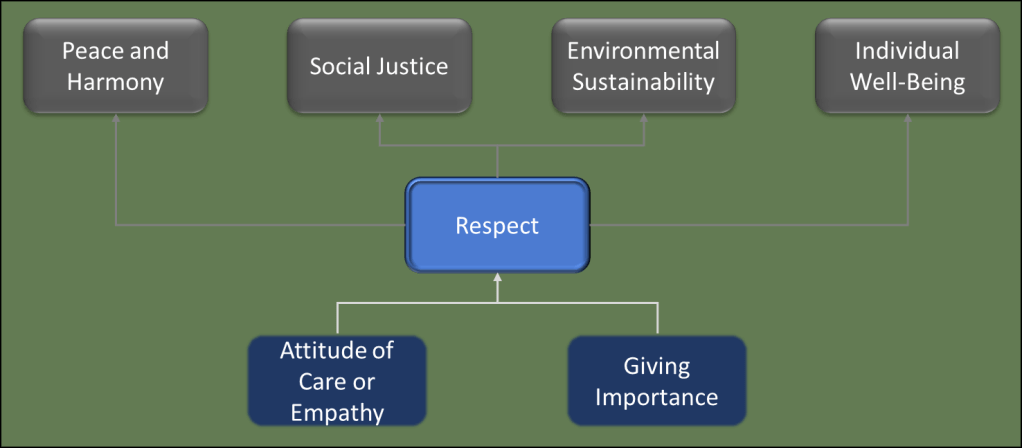
There are diverse rich private and public benefits of learning to respect and practicing it regularly. Could respect be the single most important behavioural attribute that we need to foster in each of us in today’s times? And if we had adopted respectful behaviour earlier, how much better could we and our society have been by now?
Surely there are other important behavioural attributes, both at individual and group level, that we need for more functional individuals, our society, and a more harmonious world. For instance, devoting adequate time and attention is a much-needed behavioural attribute to understand complex ecological and environmental issues of our times and in our so-called advance or developed societies, to learn about potential solutions, and even more so to convert existing knowledge and wisdom into action. But would we pay that attention if we do not have a good practice of respectful behaviour to start with? The centrality of developing respect as a central value seem important, even crucial, to develop a better human civilization that appreciates its powerful role in nature and makes a positive contribution to nature.
But what is respect? There are many definitions in dictionaries and this one sums it up pretty well:
“Polite behaviour or care towards somebody/something that you think is important.”
Apart from the polite or caring behaviour, respect also involves giving importance. The definitions also link respect to you, both in terms of your attitudes and actions.
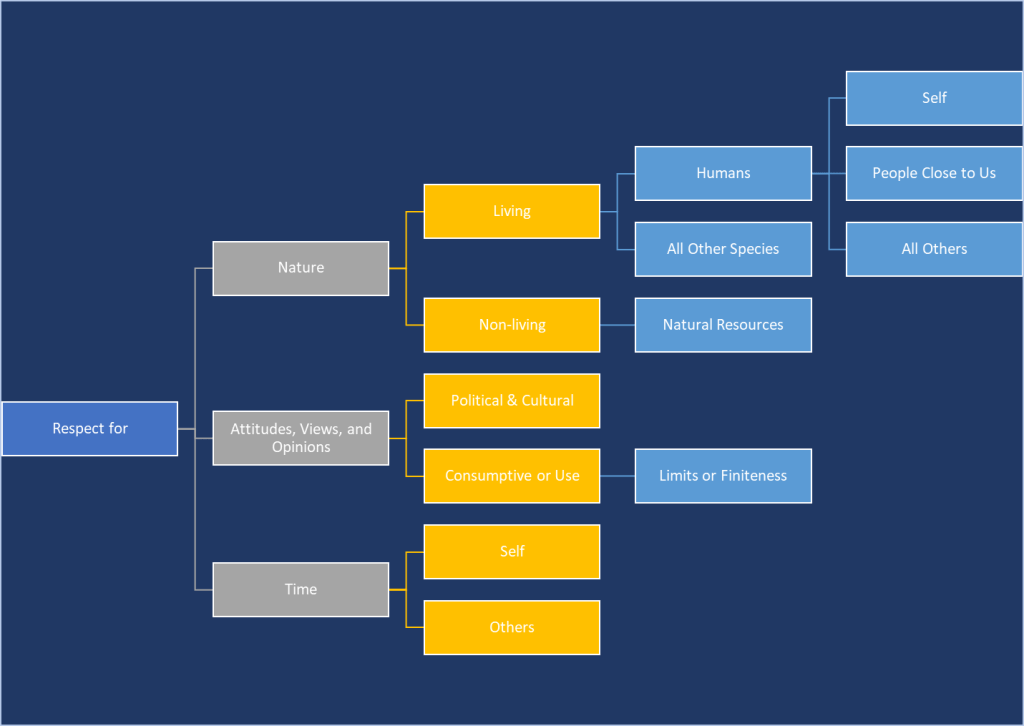
So how do we act on this little bit of knowledge about respect? Can we reflect on our behaviour as individuals and groups and try to practice respect, say one instance at a time? Would it be asking for too much? Perhaps it would not be too difficult if we can change about habits and make respectful behaviour a part of our habitual or default behaviour. Then it could become largely effortless, even automatic! Likewise, if our societies and systems start to change in this direction, their structural forces would steer individual behaviour in the desired direction.
Further Reading
Campbell, David. 2024. “A Matter of Respect: A Review Essay about Respect and Loathing in American Democracy: Polarization, Moralization, and the Undermining of Equality.” Political Science Quarterly, October 16, qqae114. https://doi.org/10.1093/psquar/qqae114.
Dillon, Robin S. 2003. Respect. September 10. https://plato.stanford.edu/ENTRIES/respect/.
Ianos, Ioan, Daniel Peptenatu, and Daniela Zamfir. 2009. “Respect for Environment and Sustainable Development.” Carpathian Journal of Earth and Environmental Sciences 4 (1): 81–93.
Miller, Dale T. 2001. “Disrespect and the Experience of Injustice.” Annual Review of Psychology 52 (Volume 52, 2001): 527–53. https://doi.org/10.1146/annurev.psych.52.1.527.
Taylor, Paul W. 2008. “The Ethics of Respect for Nature.” In The Ethics of the Environment. Routledge. Taylor, Paul W. 2011. Respect for Nature: A Theory of Environmental Ethics. Princeton University Press.
 Environment & Human Behaviour