
The current level of carbon emissions on Earth are more than what the planet can take without further warming of the atmosphere. The natural capacity of earth’s systems to retire these emissions is smaller than what we are emitting. By how much are we exceeding our carbon budget?
- 10%?
- 50%?
- 100%?
- 500%?
- Other (think of your answer)
Hold on to your answer. The answer is somewhere in this blog.
To get to the answer, let us first step back to understand basics of global warming, net-zero, and carbon budget.
Global warming is a central feature of climate change. Carbon dioxide and other heat-trapping gases in the atmosphere warm the planet 1,2. Human activities have raised the atmosphere’s carbon dioxide level. There is consensus amongst scientists on this and related findings that emphasize that increased human activities have released way too much carbon dioxide and other heat-trapping gases than the finite capacity of Earth’s thin atmosphere to handle3. While some amount of these heat-trapping gases (henceforth called carbon for simplicity) are essential to keep the planet warm enough to serve as a comfortable thin blanket to sustain life on the planet, too much of these gases have disturbed the balance leading to very dangerous changes in climate affecting not only humans but life in general4,5.
You must have heard of net-zero, the notion that there would be a time in the future when human civilization would novel technologies such that there are no more net carbon emissions6. All our carbon emissions would be captured in some way, not only by trees but also through modern technologies such as carbon capture and storage. Let us assume that it is possible to reach net-zero in next few decades, although it may not really be possible, as we want to consider the idea in hope of a better future.
A very large share of the emitted carbon is absorbed by the seas and oceans, leading to their steady acidification7, but the residual is also a bit too much for a stable climate. How much is a reasonable level to have in the atmosphere? This has been estimated based on a level of warming as seen in mean temperature as compared to pre-industrial period or 1800’s. This limit of the total reasonable level of carbon can used to derive a carbon budget for the planet, say on a per-year basis or a per-person-year basis. If the total remaining capacity is 100 units of carbon and we need 20 years to reach net-zero (to master the technologies, to curtail our wasteful lifestyles, etc.), we have an average budget of 5 units per year.
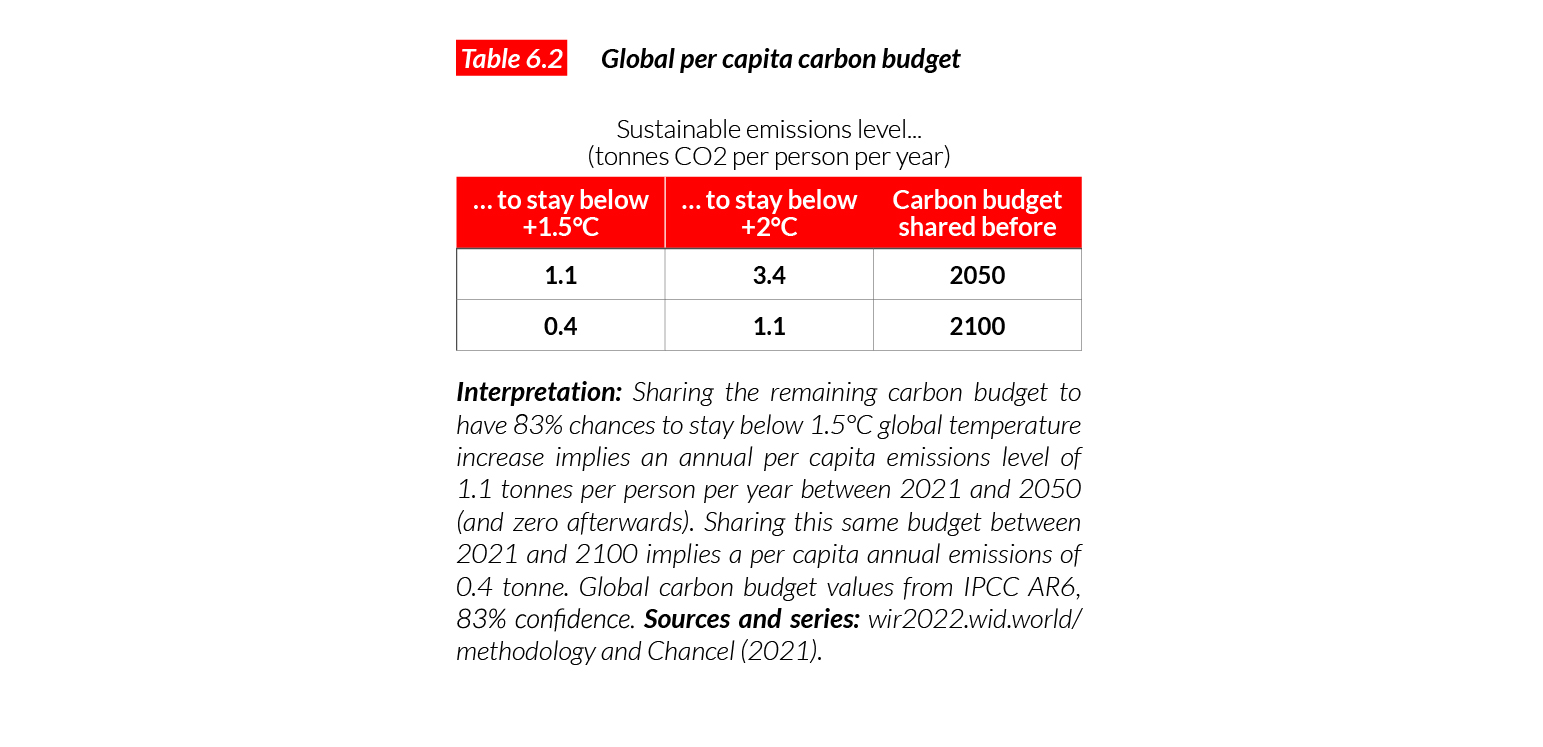
Some years ago, while reading the World Inequality Report 2022 8, the number on carbon emissions per person got me thinking. The report implied that we are emitting 6 to 16 times (600% to 1600%) more than our budget for getting to net-zero. That was shocking Figure 1. I wondered why are continuing with our current flawed systems and behaviours if we are that much over budget!

Figure 1. Carbon budget based on 2021 data (Source: https://wir2022.wid.world/www-site/uploads/2021/10/CH6-T6.2-1.jpg)
As per the report, on an average, we emit more than 6 tons of carbon in a year on a per-person basis. To move to net-zero by 2050 and to keep warming within the 1.5°C target, we can afford to emit only 1.1 tons, or 16% of the current level on an average in the intervening years. Or we will miss the target. And then no net emissions after 2050. But all this is not at all easy to do, especially given the large dependence on fossil fuels in our current ways of production and consumption.
Worse, if we take longer to reach net-zero, we have less budget per year. For instance, if we take till the end of the century, we can afford only 6% of current level (0.4 tons). Even if we take 2°C target, we can afford only about 50% (3.4 tons) or 16% (1.1 tons) of the current level depending on 2050 or 2100 for reaching net-zero emissions.
I found this information quite stark and I tried to share it to discuss it with friends. In the process, I also felt that carbon budget is very poorly understood. To understand it better and to share it further, I recently did the calculations myself (Figure 2). Alas, the results are about the same!
My calculations show the same scary situation that we are living way over the budget. World Inequality Report used total remaining carbon budget as 300 and 900 billion tons for 1.5°C and 2°C, respectively. Based on slightly more recent data from Our World in Data9, the carbon budget is even lower at 100 and 800 billion tons respectively. While per-capita emissions are a bit lower (6.6 tons vs 5.1 tons) in my calculation, the per-person carbon budget has further reduced.
We have almost exhasuted our carbon budget to handle global warming.
| Current Annual Carbon Emissions (million tons) | 41,000 | |
| Human Population (million) | 8,020 | |
| Current per-capita Carbon Emissions (tons) | 5.1 | |
| Scenarios for Our Future | Scenario 1 | Scenario 2 |
| Target Temperature (°C) | 1.5 | 2.0 |
| Residual Carbon Emissions (million tons) | 100,000 | 800,000 |
| Target Year to Exhaust Budget (Net-Zero) | 2050 | 2100 |
| Years Remaining from 2022 (recent year) | 28 | 78 |
| Remaining Per-capita Carbon Emissions Budget (tons) | 0.4 | 1.3 |
| Factor of Reduction Needed Now | 11 | 4 |
| Percent Reduction Needed Now | 91% | 75% |
| Years of budget at current emissions | 2.4 | 19.5 |
Figure 2. Carbon budget based on recent data (from the website our World in Data9)
Figure 2 suggests 2.4 years from 2022 for reaching 1.5°C. And recent news suggest that we have indeed touched 1.5°C in 202410. We are now on our way to 2°C and at the current rates of consumption and production, we will easily get there in less than two decades.
Is there any good news? Yes, there is some. One, there some are less-polluting technologies in place (less as compared to how fossil fuels are typically used). Two, the trend of per-capita emissions is downwards in high-burden countries, such as the USA 11. But these are just not enough as any scientist would tell you. What is really troubling is that we (humans around the world) still seem to be aspiring for the fabled American Dream type of lifestyle which is divorced from nature’s realities. We do not still see that what was once a cherished dream and aspirational has actually been a definite nightmare for life on Earth, including the life of humans.
And it is not as-if our leaders did not know or see it coming. By early 20th century, many leaders in India had spoken about it. Not only Gandhiji1 but also Radhakamal Mukerjee, J C Kumarappa and several other scholars. They not only pointed to the issues also provided the solutions. At the risk of over simplification, it is essentially about nature-based solutions and reasonable consumption within local or regional carrying capacity 13–16.
But are we ready to wake up from our (possibly unconscious) American Dream and face the reality? Or are we destined to sleep on while the civilization slowly but surely moves to larger crises and emergencies?
References
1. Change, N. G. C. Carbon Dioxide Concentration | NASA Global Climate Change. Climate Change: Vital Signs of the Planet https://climate.nasa.gov/vital-signs/carbon-dioxide?intent=121.
2. Arrhenius, S. On the Influence of Carbonic Acid in the Air upon the Temperature of the Ground. Philosophical Magazine and Journal of Science 5, 237–276 (1896).
3. US EPA, O. Understanding Global Warming Potentials. https://www.epa.gov/ghgemissions/understanding-global-warming-potentials (2016).
4. Gates, B. How to Avoid a Climate Disaster: The Solutions We Have and the Breakthroughs We Need. (Vintage, 2021).
5. Rockström, J. et al. A safe operating space for humanity. Nature https://www.nature.com/articles/461472a (2009) doi:10.1038/461472a.
6. UN. Net Zero Coalition. United Nations https://www.un.org/en/climatechange/net-zero-coalition (2024).
7. US EPA, O. Climate Change Indicators: Oceans. https://www.epa.gov/climate-indicators/oceans (2016).
8. Chancel, L., Piketty, T., Saez, E., Zucman, G., & others. World inequality report 2022. World Inequality Lab, Paris (2022).
9. Ritchie, H. & Roser, M. How much CO2 can the world emit while keeping warming below 1.5°C and 2°C? Our World in Data (2023).
10. 2024 is on track to be hottest year on record as warming temporarily hits 1.5°C. World Meteorological Organization https://wmo.int/news/media-centre/2024-track-be-hottest-year-record-warming-temporarily-hits-15degc (2024).
11. Ritchie, H. & Roser, M. Per Capita CO2 Emissions. CO₂ and Greenhouse Gas Emissions https://ourworldindata.org/explorers/co2?facet=none&country=CHN~USA~IND~GBR~OWID_WRL~BTN&hideControls=false&Gas+or+Warming=CO%E2%82%82&Accounting=Production-based&Fuel+or+Land+Use+Change=All+fossil+emissions&Count=Per+capita (2025).
12. The Green Gandhi | Environment | Articles on and by Mahatma Gandhi. https://www.mkgandhi.org/articles/green-Gandhi.php.
13. Guha, R. Speaking With Nature: The Origins of India’s Environmentalism. (Fourth Estate, New Delhi, 2024).
14. Govindu, V. M. & Malghan, D. The Web of Freedom: JC Kumarappa and Gandhi’s Struggle for Economic Justice. (Oxford University Press, 2016).
15. Schumacher, E. F. Small Is Beautiful: Economics as If People Mattered. (Vintage Books, 1977).
16. Guha, R. How Much Should a Person Consume?: Environmentalism in India and the United States. (Univ of California Press, 2006).
P.S.: Did you find the answer to the quiz question on how much are we over our budget? And can you calculate your own footprint (including the footprint of your savings and investments) for a comparison?
- He wrote, “God forbid that India should ever take to industrialization after the manner of the West. The economic imperialism of a single tiny island kingdom (England) is today keeping the world in chains. If an entire nation of 300 million took to similar economic exploitation, it would strip the world bare like locusts.” 12 ↩︎
 Environment & Human Behaviour