
Would you like the world to replace people to stay at the current headcount or would you rather reduce?
Have you heard of the population replacement rate? Calculations show that these days about 2.1 child per woman is needed to ensure that population does not go down. Surely you have heard of this one, or something similar that tries to steer us into believing that there is something sacrosanct about the current number of people. That we must somehow hold on to current population and not let it fall.
Should we not ask why is the current population the right level to hold on to? Why not what it was, say ten years ago, or a hundred years ago? This simple question suggests that there is an inherent flaw in the logic of seeking to stay at the current population.
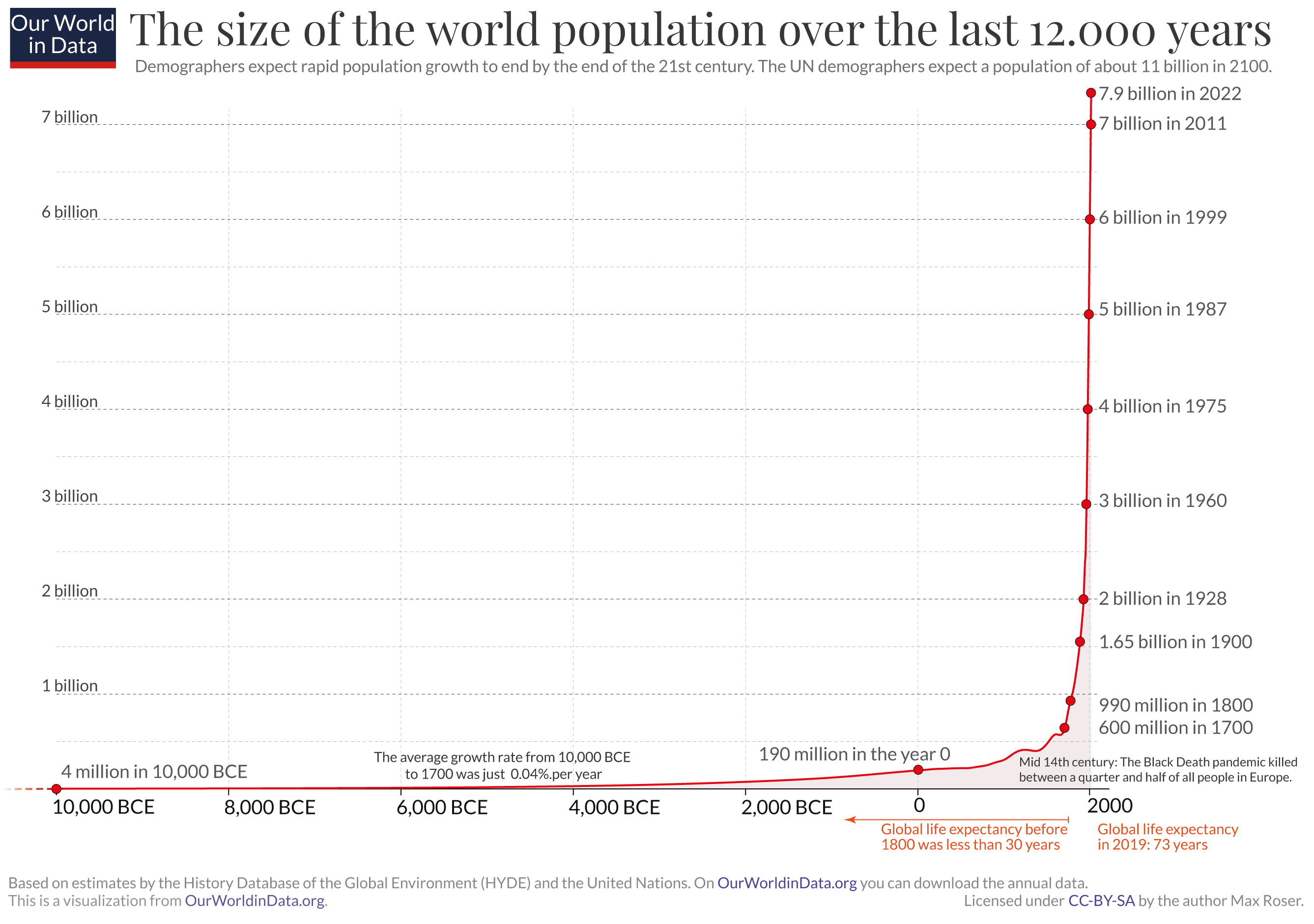
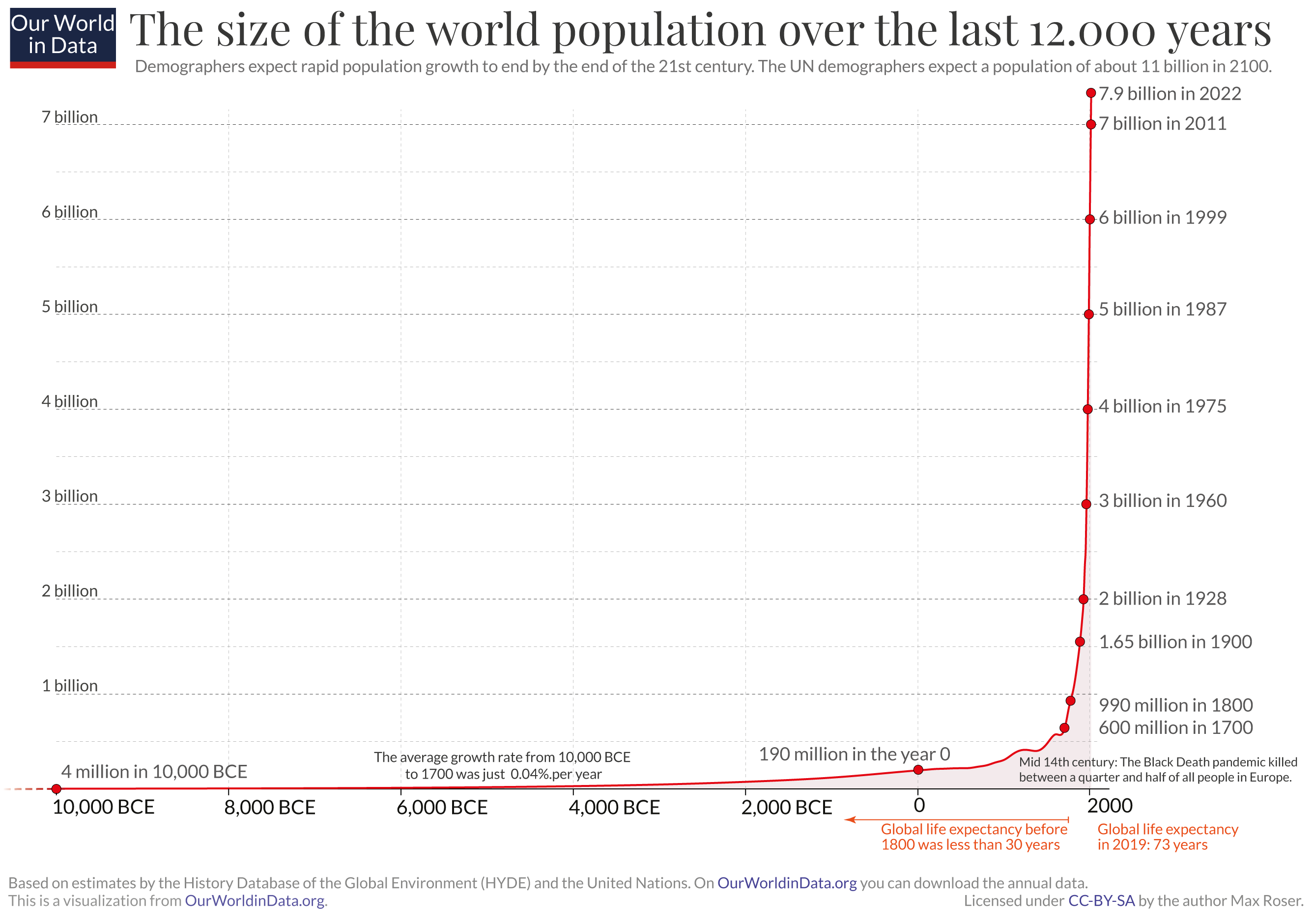
Source: https://ourworldindata.org/uploads/2022/03/Annual-World-Population-since-10-thousand-BCE.png. An interactive version can be found here.
Let’s also mind that such discussions on population typically happen at a national level, trying to scare national policy makers and through them the people, not to let the population reduce. What about the scary or at least very painful effects of the enormous growth of population that we have been through? Hasn’t having so more people also been a massive problem, such as the need to supply ever more fresh water when it is finite and also increasingly polluted, driven by increased human activity and waste? Or, did the people making the case for replacement rate miss out how population has surged in the last few hundred years?
Let’s explore where did this idea of replacement rate or preserving current population come from. Perhaps from someone’s personal or collective belief about what is good for the society, perhaps an economist or policy expert in-charge of growth? Yes, having fewer people is a big problem for those who are focused on economic growth or size of the economy. After all, that’s how politicians and nations gain heft on the global scene – larger number of people make them look big and powerful. If that’s what you care for, consider that we live on a finite planet, not an expanding one that can accommodate population growth endlessly.

Looking at a more personal level of this dramatic change, if humans are living longer and fewer of us are dying at a young age, that may be great for us as families and friends. But collectively it does what we see in the chart – population explosion. While having fewer children is one obvious option, having children later in life is another option to keep the population low. Adoption of children is yet another option. Such behaviours, though uncommon in population discussions, can help in reducing the growth rate and eventually reducing global population, without being scared about a smaller population. Most nations and states have already dealt with such massive burst of growth in the number of humans in their finite part of the planet, they can also learn how to deal with a slow decline, or even a somewhat fast decline.
Sources and further reading:
Interactive chart on global population from 10,000BCE to 2100
 Environment & Human Behaviour
3 responses to “Replace Population or Reduce?”
Vivek, agree with your thoughts.
Population growth puts more pressure
on environment and infrastructure
both physical and social
LikeLike
The recent discussions in India about the upcoming delimitation exercise for nation’s parliamentary seats has provided an interesting pivot for the population discourse, perhaps unwittingly. The Chief Minister of Karnataka has suggested that 1971 census should be used as the point of reference, not a later population. While some states successfuly controlled their population’s growth, many others failed. To be fair to those who succeeded in limiting their growth, a reference in the past makes a lof of sense. No?
Maybe India can target to bring back its population to what it was in 1971?
LikeLike
An important new article on population with some very interesting comments
https://steadystate.org/introducing-the-sustainable-population-and-immigration-act/
LikeLike